

Elsewhere

Group Exhibition
Nida Sinnokrot | untranquil now
Hamburger Kunsthalle
In the exhibition untranquil now, attention is focused on artworks, artefacts, performances, figures and events, that authorize complexity, in which bodies and modes of perception become the agents of contradictory states and troubled histories. Nida Sinnokrot’s works Flight – Jalazone (2016), When Her Eyes Lifted (1998/2016), Ya Ghanamati (Billboard No. 02) (2014) and Exquisite Rotation (Fakir Fans) (2015) are included in the exhibition. Sinnokrot’s work is informed by cinema, colonial history, narrative structures, and the politics of technology. Through tactical acts of technical and conceptual détournement, his work aims to subvert various technologies of control that give rise to shifting social, political, and geographic instabilities.

Solo Exhibition
Pakui Hardware | Virtual Care
Radvila Palace Museum of Art, Vilnius
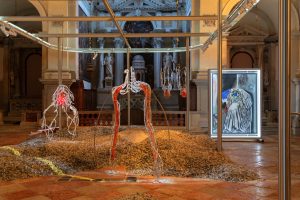
The historic hall of Radvila Palace is transformed into an environment that resembles a clinical surgery or hospital room, where human presence, with the exception of the visitors’ own physicality, is replaced by technology. Suspended between the physical and the virtual, the bodily and the digitised, the space is inhabited by transparent thermoformed ‘bodies’ abstracted into sculptural biomorphic shapes. Influenced by Lithuanian artist Marija Teresė Rožanskaitė’s paintings from the 1970s and 80s, the sculptures merge technology, draperies, organic and synthetic materials into abstracted states.

Prize
Tarik Kiswanson Winner of the Henraux Sculpture Prize
Tarik Kiswanson is one of the three winners of the 6th Edition of the Henraux International Sculpture Prize.
Duo Exhibition
Pakui Hardware | Inflammation – Biennale Arte 2024
The Lithuanian Pavilion, Venice
Pakui Hardware represent Lithuania at the 60th International Art Exhibition of La Biennale di Venezia, together with the works by modernist Lithuanian artist Marija Teresė Rožanskaitė, opening on Saturday, 20 April 2024. The immersive joint exhibition of Pakui Hardware and Marija Teresė Rožanskaitė will address the ‘inflammations’ currently affecting humanity and the world. The Lithuanian pavilion is organized by the Lithuanian National Museum of Art (commissioner: Arūnas Gelūnas) and curated by Valentinas Klimašauskas and João Laia. The installation’s architecture will be made by Ona Lozuraitytė and Petras Išora. Inflammation is commissioned by the Ministry of Culture of the Republic of Lithuania, presented by the Lithuanian National Museum of Art, and financed by the Lithuanian Council for Culture.

Solo Exhibition
Tarik Kiswanson | A Century
Portikus, Frankfurt
Delving into both biographical and collective history, in the exhibition A Century, Tarik Kiswanson unearths the complexities of historical events of the last hundred years of war, destruction and regeneration and how these resonate across generations and geographies. His practice spans media ranging from sculpture to drawing and film, and from sound and spatial interventions to poetry. Across various corpus, each work serves as a vessel that carries intricate narratives and transports traces of the past and the present. Composed of a series of recently conceived sculptures, Kiswanson’s exhibition unfolds in separate chambers formed by two high walls that divide the main gallery of Portikus.
Solo Exhibition
Paul Pfeiffer | Prologue to the Story of the Birth of Freedom
The Museum of Contemporary Art, Los Angeles

Surveying twenty-five years of the multi-disciplinary practice of artist Paul Pfeiffer (b. 1966, Honolulu, Hawaii; lives in New York), Paul Pfeiffer: Prologue to the Story of the Birth of Freedom will celebrate a pioneering artist known for his incisive work that interrogates ideas of spectacle, belonging and identity. Inspired by televised sporting events and popular entertainment, Pfeiffer’s work deconstructs our fascination and obsession with celebrity culture, unpacking how collective consciousness is shaped and manipulated through his masterful editing of found footage. In tracing the global trajectory of image circulation, Pfeiffer demonstrates how desire, heroism and worship operate as part of the mechanisms of art, religion, politics, and nationhood. Bringing together more than thirty works and debuting a new commission, Paul Pfeiffer: Prologue to the Story of the Birth of Freedom is the first retrospective of the artist’s multi-disciplinary practice.
Solo Exhibition
Julie Mehretu | Ensemble
Palazzo Grassi, Venice
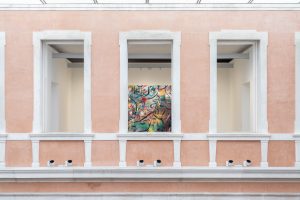
Presented at Palazzo Grassi from 17 March 2024 to 6 January 2025, “Ensemble” is the largest exhibition of Julie Mehretu’s work to date in Europe. Curated by Caroline Bourgeois, Chief Curator of the Pinault Collection, with Julie Mehretu, the exhibition brings together a selection of more than fifty works, between painting and printmaking, that the artist produced over the timespan of 25 years, including several of the artist’s recent paintings from 2021-2024. Presented over two floors of Palazzo Grassi, the exhibition unites 17 works from the Pinault Collection, as well as loans from international museums and private collections.